I support a Board and need to know what comes next.
Practical tools and education for the people behind Boards, committees and governance — whatever kind of organization you work in. The Board cycle behaves the same way in a nonprofit, an association, a health authority, a school board, a public body or a corporate boardroom.
Written for every role that keeps a Board running.

Practical digital tools
Resources ready for the work on your desk.
Use clear templates, guided learning and repeatable systems to prepare meetings, document decisions and carry governance work forward with confidence.
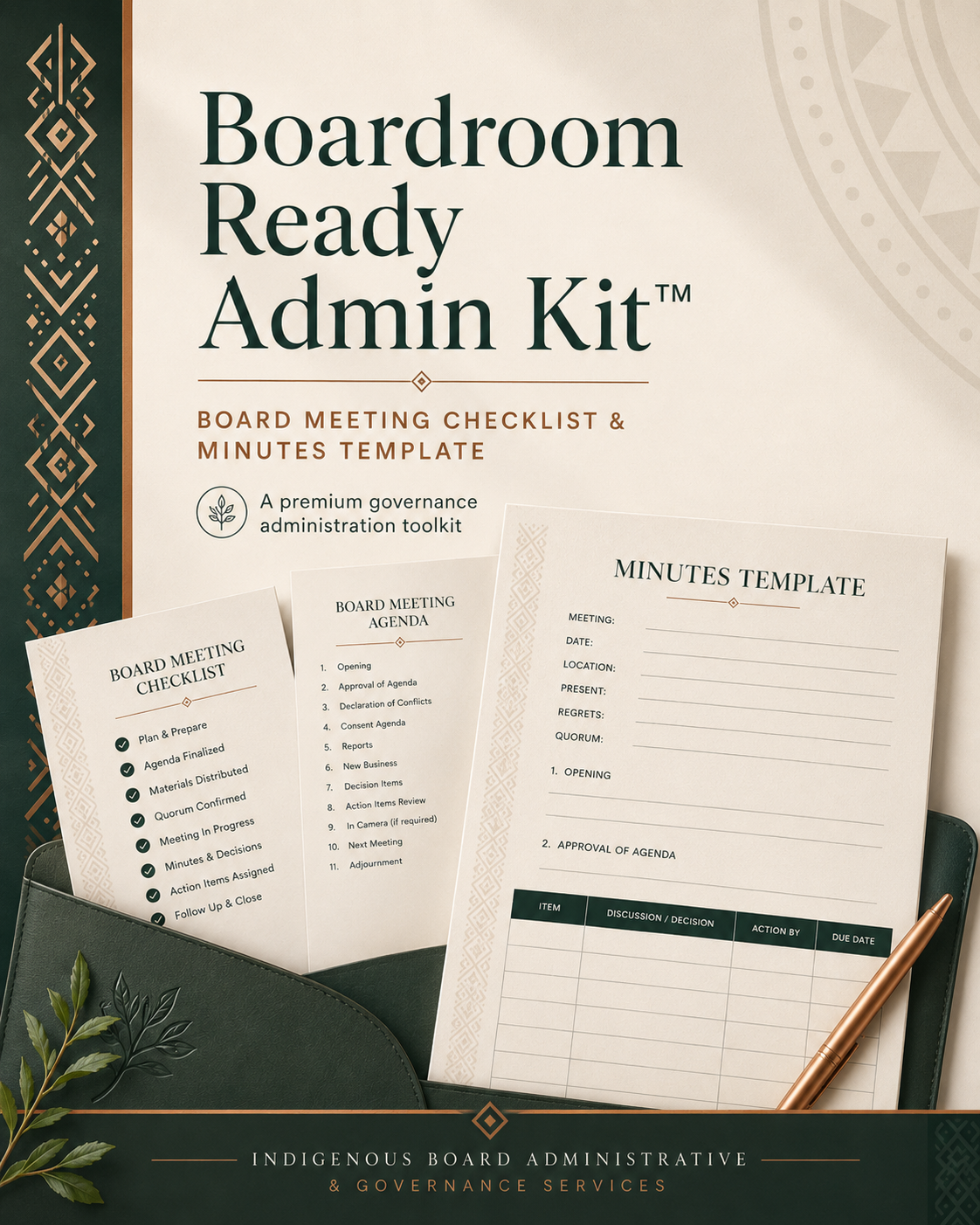
Boardroom Ready Admin Kit™
A repeatable Board meeting system: backwards-planning checklist and timeline, minutes template, and an action item tracker you can use from the next cycle onward.
Canadian Boardroom Legal & Governance Reference Guide
A Practical Learning Resource for Governance Administrators
A practical, cross-referenced guide to the legal and governance sources behind Canadian boardroom decisions. Learn where to look first, which authority controls, where Robert’s Rules fits, and when a governance question should be escalated to legal counsel.
General educational information only. Not legal advice and not a substitute for advice from qualified legal counsel.
The parts of the job nobody hands you instructions for.
Preparing the meeting
Working backwards from the meeting date so the package, materials and confirmations land on time.
Writing the minutes
Recording decisions as a governance record — accurate, consistent and defensible years later.
Tracking motions
Keeping a register so any decision can be traced to its meeting, wording and outcome.
Closing action items
What was directed, who holds it, when it is due, and what closed it.
Supporting committees
Terms of Reference, membership, reporting lines and the rhythm each committee needs.
Holding the annual cycle
Recurring approvals, reviews, filings and reporting mapped across a full governance year.
Step-by-step guidance for the work between meetings.
Everything grouped by the part of governance it belongs to.
Free practical guidance sits beside the paid tools, so you can read first and buy only what saves you time.
Board meetings
Minutes, motions & resolutions
Annual governance calendar
Committees & Terms of Reference
Director onboarding
Governance records
Legal & governance sources
Professional practice
Board administrator training, from a first template to a full certificate program.
The Administrative Role in Governance™ handbook
Pre-order the general edition for administrative professionals. Released October 29, 2026.
Governance administration certificate program
Eight self-paced modules for Board secretaries, governance coordinators and executive assistants. Releases October 29, 2026.
Boardroom Ready™ annual membership
Governance templates and tools for the whole Board year, with new resources added as they are released.
Board administration questions we are asked most.
- What does a Board administrator do?
- A Board administrator holds the governance cycle together: scheduling meetings within the notice period, building the agenda with the Chair, assembling and distributing the Board package, recording accurate minutes and motions, tracking action items to completion, maintaining governance records and policies, and supporting committees and director onboarding.
- What should be in a Board package?
- The agenda, the previous minutes for approval, the financial report, the Executive Director and committee reports, and a supporting document for every item requiring a decision — assembled in a consistent order, page-numbered, version-controlled, and circulated within the notice period set by your bylaws.
- How detailed should Board meeting minutes be?
- Minutes are a decision record, not a transcript. Record attendance and quorum, approvals, declared conflicts and recusals, each motion in its final wording with mover, seconder and outcome, action items with owners and due dates, in-camera entry and exit times, and adjournment. Summarize discussion in a line or two without attributing statements to individuals.
- What is the difference between a Board secretary and a governance coordinator?
- A Board or Corporate Secretary is usually an officer role with duties named in the bylaws or governing statute, including custody of the corporate record. A governance coordinator is generally a staff position that carries out governance administration — meeting logistics, packages, minutes, records and policy workflow — without holding officer duties. In smaller organizations one person often does both.
- How do you prepare for a Board meeting?
- Work backwards from the meeting date: about 30 days out confirm the date, notice requirements and quorum and request reports; 14 to 7 days out draft the agenda with the Chair, assemble and quality-check the package and distribute it; on the day protect the record; in the following week circulate draft minutes and open the action tracker.
- Is the Boardroom Ready certificate program live or on demand?
- It is fully self-paced and asynchronous — there are no required live sessions. The program releases October 29, 2026 and finishes with a Certificate of Completion, which is not an external professional designation or accreditation.
Board administration is a profession, not a clerical task.
More practical content, templates, meeting-cycle tools and career resources are released as they are completed. Members get them first, and the certificate program turns the same practice into a structured qualification for your file.
Be notified as each new tool is released
Templates, checklists and practical Board administration guidance as they are published.
Want to choose specific interests? Use the full sign-up form.